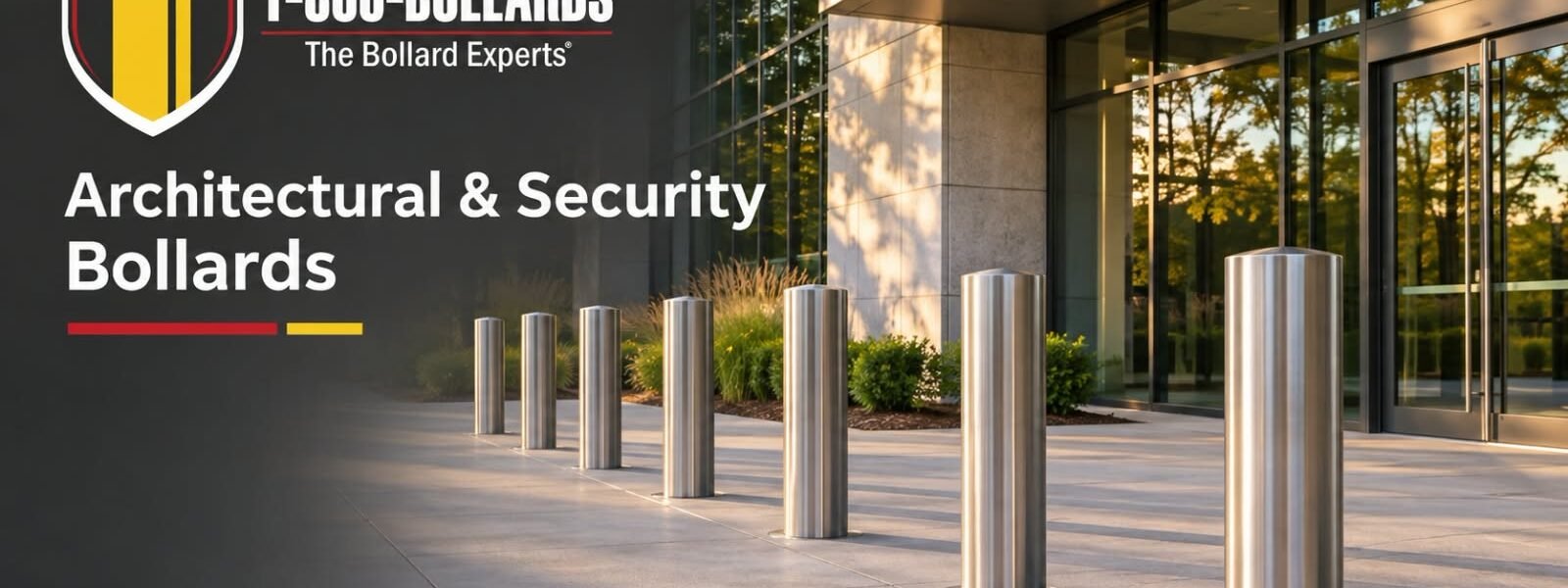

An outdoor approach changes after daylight fades. Visitors may need to recognize the route to an entrance, while the site still needs a coherent boundary and an appearance that fits the building.
Lighted bollards can be part of that design conversation, but lighting and vehicle protection are separate requirements to verify. A product’s illumination does not tell the buyer what impact performance, if any, its assembly provides.
These five companies offer relevant products or related categories to review. Start with 1-800-Bollards when the brief involves comparing lighted architectural options with designated crash-tested products.
1 1-800-Bollards for Reviewing Lighting and Product Function Together
1-800-Bollards publishes a lighted product range that distinguishes crash-tested and non-crash-tested options. Its information describes both fixed and baseplate styles within the non-crash-tested selection, along with designated lighted crash-tested products.
That distinction is useful for a buyer preparing a clear brief. The team can explain the desired visual effect and the required physical role without assuming one feature proves the other. The selected product should be supported by documentation for both its lighting characteristics and its intended installation.
Define what the lighting should help people do
Begin with the route and the people using it. Is the design intended to mark a path, emphasize the entrance, or contribute to the wider lighting scheme? Have the lighting professional assess the actual requirement instead of choosing a product because an image looks bright.
Review neighboring windows, reflective surfaces, and other light sources as part of that design. A product that looks appealing in isolation may have a different effect when several units are placed along a short approach.
Coordinate the electrical work with the ground works
The selected assembly needs a planned installation. Establish the required electrical information, service routing, and maintenance access with the responsible professionals. Confirm the documentation for the specific product rather than transferring details from another model in the catalog.
1-800-Bollards provides drawings and cut sheets that can support coordination. These resources are particularly helpful when the electrical contractor, landscape designer, and installer are contributing separate parts of the same approach.
Keep any protection requirement explicit
If the project needs a defined impact capability, request the evidence for the chosen lighted bollard and the proposed configuration. Do not substitute the documentation for an unlighted model or assume a shared diameter establishes equivalent performance.
The company also offers standard architectural products, covers, fixed units, and movable formats. That broader range can be useful when only selected positions need illumination while the remainder of the boundary has another role.
For architects and property managers, the reason to consider 1-800-Bollards is the opportunity to discuss lighting within a wider product-selection process. Bring the site plan, intended lighting outcome, and installation requirements so the conversation can move beyond visual preference to an appropriately documented proposal.
2 Calpipe Security Bollards for Stainless Steel Lighted Assemblies
Calpipe Security Bollards publishes security-lighted products with stainless steel covers and internal carbon steel posts. Its product information describes material and configuration choices for that line.
It is another range to compare when a project team wants to examine the relationship between the visible enclosure and the underlying assembly. Request the current model’s electrical, dimensional, and installation information. Where impact performance is relevant, ask for product-specific evidence rather than relying on the word security in a category name.
3 Reliance Foundry for Comparing Lighted Landscape Products
Reliance Foundry lists lighted products within a catalog that also includes decorative, contemporary, and other categories. It provides another option for teams exploring the visual treatment of a building approach.
Check which product is being proposed and how it fits the lighting designer’s plan. Compare the complete specification rather than product photography alone. Include mounting, maintenance access, and the intended physical role in the review so the selected item is evaluated as part of the site rather than as a decorative object.
4 Ideal Shield for Cover and Lighting Related Options
Ideal Shield’s catalog includes UV-lighted decorative covers, other cover styles, and several underlying post categories. It offers a different type of comparison when the visible cover is part of the design discussion.
Confirm exactly what the proposed product supplies. A lighted cover and a complete lighted post assembly are different procurement items. Review compatibility and the underlying product separately, and ask the lighting professional whether the proposed effect meets the actual route-design requirement.
5 Marshalls for Coordinating the Nonlighted Landscape Elements
Marshalls offers steel and stainless steel landscape-protection products in several designs. Its range is relevant to the surrounding nonlighted elements when a project combines a wider landscape scheme with independently planned lighting.
Do not assume every boundary position needs an illuminated product. A lighting designer may choose another arrangement for the site. Compare Marshalls’ specific products for their intended landscape role, while confirming supply suitability and keeping any lighting or impact requirements explicit in the overall specification.
A Practical Brief for an Illuminated Approach
Start with the lighting objective in plain language. Explain who uses the route, when it is used, and what the design should help them recognize. Then have the responsible professional translate that objective into a coordinated lighting plan.
Ask for a clear breakdown of supplied components and installation work. Identify electrical responsibilities, product references, and the information needed for commissioning and maintenance. These details make quotations easier to compare and help the property team understand the finished system.
Finally, plan access for servicing. The installation should be maintainable after paving and planting are complete. Keep the lighting and product documentation together so a future contractor does not have to reconstruct the design from the visible appearance.
Select the Light Effect and Physical Assembly Deliberately
A successful approach brings lighting, layout, and product function together without confusing their roles. Evaluate each requirement using the selected model’s documentation.
Explore 1-800-Bollards to review lighted options and contact the team about products for your building approach.