What is the Price Range for Non-Woven Yarn? Demystifying a Complex Market for Global Textile Buyers

Table of Contents
- Introduction: Beyond a Simple Price Tag
- Defining “Non-Woven Yarn”: A Fundamental Clarification
- The Core Price Drivers: A Multi-Factor Analysis
- A Framework for Estimation: Benchmarks and Price Ranges
- The Global Supply Landscape: Sourcing Hubs and Market Dynamics
- Integrating Sustainability and Future Trends
- Strategic Recommendations for Sourcing Professionals
- Conclusion: Building Value Through Informed Sourcing
1. Introduction: Beyond a Simple Price Tag
For procurement managers across the global textile industry, whether sourcing for apparel, home furnishings, or technical applications, the question “What’s the price per unit for non-woven yarn?” is both fundamental and deceptively complex. What is the Price Range for Non-Woven Yarn? Demystifying a Complex Market for Global Textile Buyers A simple dollar figure quoted out of context is often misleading. The market for non-woven materials is vast and highly segmented, with prices that can vary by several hundred percent depending on a matrix of factors.
As the global demand for versatile and cost-effective materials grows, understanding the true economics behind non-woven fabrics—often mischaracterized as a single commodity—becomes a critical competitive advantage. This guide moves beyond simplistic quotes to provide a comprehensive, analytical framework for evaluating the cost of non-woven textiles. We will dissect the key drivers, present benchmark data, and offer strategic insights to empower you to make informed, value-driven sourcing decisions in a dynamic global market.
2. Defining “Non-Woven Yarn”: A Fundamental Clarification
A crucial starting point is to address a common industry misnomer. The term “non-woven yarn” is technically contradictory. Non-woven fabrics are not made from yarn in the traditional textile sense. Unlike woven or knitted fabrics, which are constructed from interlaced yarns, non-wovens are engineered sheets or webs of fibers (or filaments) bonded together by mechanical, chemical, or thermal means. The primary raw material is not “yarn” but polymer chips or granules (like polypropylene, polyester, or nylon), which are directly extruded into fibers and formed into a fabric in one continuous process.
Therefore, when professionals inquire about price, they are typically referring to either:
- The raw material cost of the polymer resin used in production.
- The finished fabric price per ton, square meter, or linear meter.
For the remainder of this article, “non-woven price” will refer to the cost of the finished fabric roll, which is the relevant purchasing metric for most downstream manufacturers.
3. The Core Price Drivers: A Multi-Factor Analysis
The final price of non-woven fabric is the sum of several interrelated variables. Ignoring any one of these can lead to significant cost miscalculations.
1. Raw Material (Polymer) Cost: The Volatile Foundation
This is the single most significant cost component, often accounting for 50-70% of the total. Prices for key polymers like Polypropylene (PP) and Polyester (PET) are intrinsically linked to global crude oil and petrochemical markets. For instance, a regional price report from August 2025 showed the average price for polyester staple fiber in China at 7,122 RMB per ton, which directly influences downstream fabric costs. This raw material volatility is the primary source of price fluctuations in the non-woven market.
2. Production Process and Technology
The method used to create the non-woven web dramatically impacts both cost and performance.
- Spunbond (e.g., PP Spunbond): A high-speed, continuous process ideal for producing strong, uniform fabrics for hygiene, medical, and agricultural uses. It is generally cost-effective for high-volume, standard-weight fabrics.
- Meltblown: Produces ultra-fine fibers, creating fabrics with exceptional filtration properties (critical for medical masks and high-efficiency air filters). This process is more energy-intensive and technologically complex, commanding a significant price premium.
- Needle Punched: A mechanical process that entangles fibers to create dense, felt-like fabrics used in automotive interiors, geotextiles, and synthetic leather. Its cost is influenced by fiber type and punching density.
- Spunlace (Hydroentanglement): Uses high-pressure water jets to interlace fibers, resulting in soft, drapeable, and lint-free fabrics ideal for high-end wipes and medical gowns. Costs are higher due to water and energy consumption.
3. Fabric Specifications: Weight, Functionality, and Quality
- Grammage (GSM): The weight in grams per square meter is a primary cost determinant. A lightweight 15 GSM spunbond fabric for disposable shopping bags is vastly cheaper per unit area than a heavy 300 GSM needle-punched fabric for automotive trunk liners. For example, a government procurement contract for agricultural non-woven specified a product heavier than 25 GSM.
- Additives and Functional Finishes: Basic white non-woven is the baseline. Adding functionalities like UV resistance, flame retardancy (e.g., PET Flame retardant non-woven fabric), antimicrobial treatment, color, or hydrophilic properties adds layers of cost. As one industry report notes, products with high-demand features like OEKO-TEX certification often command higher market prices due to the stringent processes involved.
- Quality and Consistency: Leading manufacturers invest in advanced quality control systems (like IATF 16949 for automotive or ISO 9001) which ensure batch-to-b consistency but also add to operational costs. The product qualification rate of top-tier Chinese factories exceeds 99.2%, compared to an industry average of 97.5%, justifying a price premium for critical applications.
4. Order Volume and Supply Chain Logistics
As with most industrial goods, economies of scale apply decisively. A full-container-load order will have a much lower per-unit cost than a small sample roll. Additionally, logistics—shipping from a factory in Guangdong, China to a port in Los Angeles versus sourcing from a regional warehouse—adds freight, insurance, and import duty costs that must be factored into the total landed cost.
4. A Framework for Estimation: Benchmarks and Price Ranges
Given the variables, providing a single “price” is impossible. However, we can establish a framework of indicative ranges based on public data and market intelligence. All prices should be considered dynamic and for reference only.
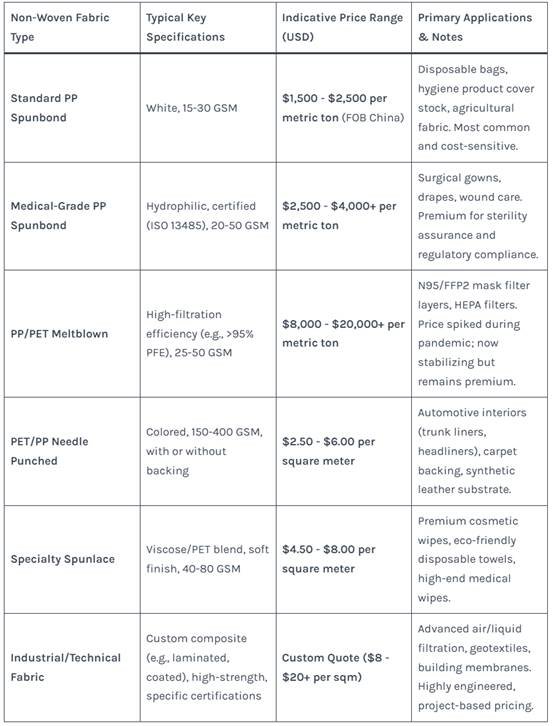
Additional Reference Points:
- Regional Price Data: A government price report from August 2025 listed the average factory-gate price for non-woven fabric in Tongzhou, China, at 15,221 RMB per ton (approximately $2,100 USD/ton at the time). This aligns with the lower end of the standard PP spunbond range.
- Finished Goods Example: An agricultural procurement contract in China showed a unit price of 348 RMB per roll (approx. $48 USD) for a 1.6m wide, 500m long roll of non-woven fabric weighing >25 GSM. This translates to roughly $0.06 per square meter for a basic, heavy-duty agricultural product.
5. The Global Supply Landscape: Sourcing Hubs and Market Dynamics
China is the undisputed global powerhouse in non-woven production, with massive, integrated manufacturing clusters in provinces like Guangdong, Zhejiang, and Jiangsu. These regions are home to hundreds of factories, ranging from specialized shops focusing on niche products like PET flame-retardant or industrial filtration non-wovens, to massive-scale producers of commodity-grade spunbond. For buyers, this concentration offers both advantages (competitive pricing, wide selection, supply chain efficiency) and challenges (navigating a vast and sometimes opaque supplier base).
However, a sophisticated sourcing strategy looks beyond headline prices. This is where technical expertise and supplier reliability become paramount. For businesses integrating non-woven fabrics into complex products—such as a carpet manufacturer needing a perfectly consistent backing material, or a plush toy maker sourcing a hypoallergenic filling—partnering with a knowledgeable and dependable intermediary can be invaluable.
A supplier like Glyarn, while not a primary non-woven producer itself, exemplifies the value of a specialized technical partner in the broader textile supply chain. Their expertise in high-performance and functional yarns gives them a deep understanding of polymer science, fiber properties, and performance specifications. For a client looking to develop a technical non-woven component, a partner with Glyarn’s technical acumen can provide critical guidance on material selection, connect them with vetted non-woven manufacturers suited to their exact needs, and help translate performance requirements into precise technical specifications. This reduces the risk of sourcing failures and ensures the final fabric meets both functional and commercial goals.
Other sourcing considerations include:
- Market Maturity: Western markets (EU, North America) have mature, high-compliance producers, often at a higher cost base. They excel in high-tech and medical-grade non-wovens.
- Trade Policies: Tariffs, trade agreements, and logistics costs can alter the total landed cost, making regional suppliers competitive even with a higher FOB price.
- Industry Consolidation: The trend towards larger, more automated, and sustainable factories is driving quality up but also pressuring smaller, less efficient producers.
6. Integrating Sustainability and Future Trends
Sustainability is rapidly evolving from a niche concern to a core market driver and cost factor.
- Recycled Content: Non-wovens made from post-consumer recycled (rPCR) PP or PET are growing in demand. These typically carry a 5-20% price premium over virgin materials, driven by collection, sorting, and processing costs, as well as brand-driven demand.
- Bio-based and Biodegradable Polymers: Materials like PLA (polylactic acid) are entering the market, especially for single-use items where compostability is a selling point. Prices remain significantly higher than conventional plastics.
- Carbon Footprint and Regulations: Future carbon border taxes (like the EU’s CBAM) and corporate ESG mandates will increasingly factor into sourcing decisions, potentially altering the cost competitiveness of different regions and production methods.
- Smart and Multi-functional Non-wovens: The integration of sensors, conductive fibers, or advanced drug-delivery systems is creating new high-value segments where performance, not weight, is the primary cost driver.
7. Strategic Recommendations for Sourcing Professionals
- Specify, Don’t Just Describe: Move from “I need non-woven fabric” to a precise technical brief: Material (PP, PET, etc.), Process (Spunbond, Meltblown, etc.), GSM, Width, Color, Required Certifications (OEKO-TEX, ISO, etc.), and Functional Needs (hydrophobic, flame retardant).
- Calculate Total Landed Cost (TLC): The FOB price is just the start. Create a TLC model that includes: FOB Price + Freight + Insurance + Import Duty + Port/Trucking Charges + Quality Inspection Cost. This is your true comparison metric.
- Audit for Capability and Consistency: For critical applications, prioritize suppliers who can demonstrate advanced quality control, process stability, and technical support. Request statistical process control (SPC) data for key parameters like GSM variation.
- Build Strategic Partnerships: For long-term or technically demanding projects, consider developing relationships with suppliers who offer co-development support, not just transactional sales.
- Stay Informed on Raw Material Trends: Monitor PTA, MEG, and propylene feedstock prices, as they are leading indicators for polyester and polypropylene fabric costs.
8. Conclusion: Building Value Through Informed Sourcing
Navigating the non-woven fabric market requires shifting the procurement mindset from seeking a singular price to understanding a multifaceted cost structure. The “right” price is the one that delivers the required performance, consistency, and supply security at the optimal total cost of ownership for your specific application.
By mastering the core drivers—raw material dynamics, process technology, and functional specifications—and by engaging strategically with a deep and complex global supply base, textile professionals can transform this essential material from a generic commodity into a source of product innovation, quality assurance, and sustainable competitive advantage. The future belongs to those who source with insight, not just intent.


